

AI & Automation
Automate the right work. Keep people in control.
BRS designs practical AI automation, workflows, integrations and decision-support tools for Melbourne businesses. The objective is useful operational change, with people kept in control—not adding AI for its own sake.
Discuss a workflowBefore the technology
Not every process should be automated.
Some work is repetitive, rules-based and ready to be handled more consistently. Some depends on context, judgment or a conversation that should remain human.
BRS begins by examining how the work currently moves: what starts it, which information is required, where decisions are made, what can go wrong and where a person needs to remain responsible.
Automation is useful when it reduces avoidable handling without hiding important decisions or creating a more fragile process underneath.
A governed workflow
Automation and review have different jobs.
- 01Automated
Trigger
A defined event starts the workflow.
- 02Automated
Validate
Required inputs and conditions are checked.
- 03Assisted
Classify
Information is organised with visible confidence and rules.
- 04Human
Review
A person handles judgment, ambiguity or approval.
- 05Controlled
Act
The approved action is completed or routed.
- 06Automated
Record
The result and relevant context remain traceable.
This sequence is a decision model, not a claim that every engagement uses the same automation. Review points, permissions and failure paths are defined for the actual workflow.
Practical applications
Applied to real operational work.
- Workflow analysis
- Map repeated handling and decide where automation would genuinely improve it.
- Assistants
- Help people find, summarise or act on relevant information while keeping the final decision visible.
- Lead handling
- Capture, validate, classify and route enquiries so the right person receives usable information.
- Reporting
- Bring information together, calculate useful measures and prepare recurring operational views.
- Classification
- Organise incoming information using defined categories, confidence thresholds and review paths.
- Integrations
- Move information between existing tools while preserving validation, ownership and traceability.
These are examples of work BRS can provide. They are not presented as completed client case studies or guaranteed outcomes.
Decision support
BRS-built product · Live
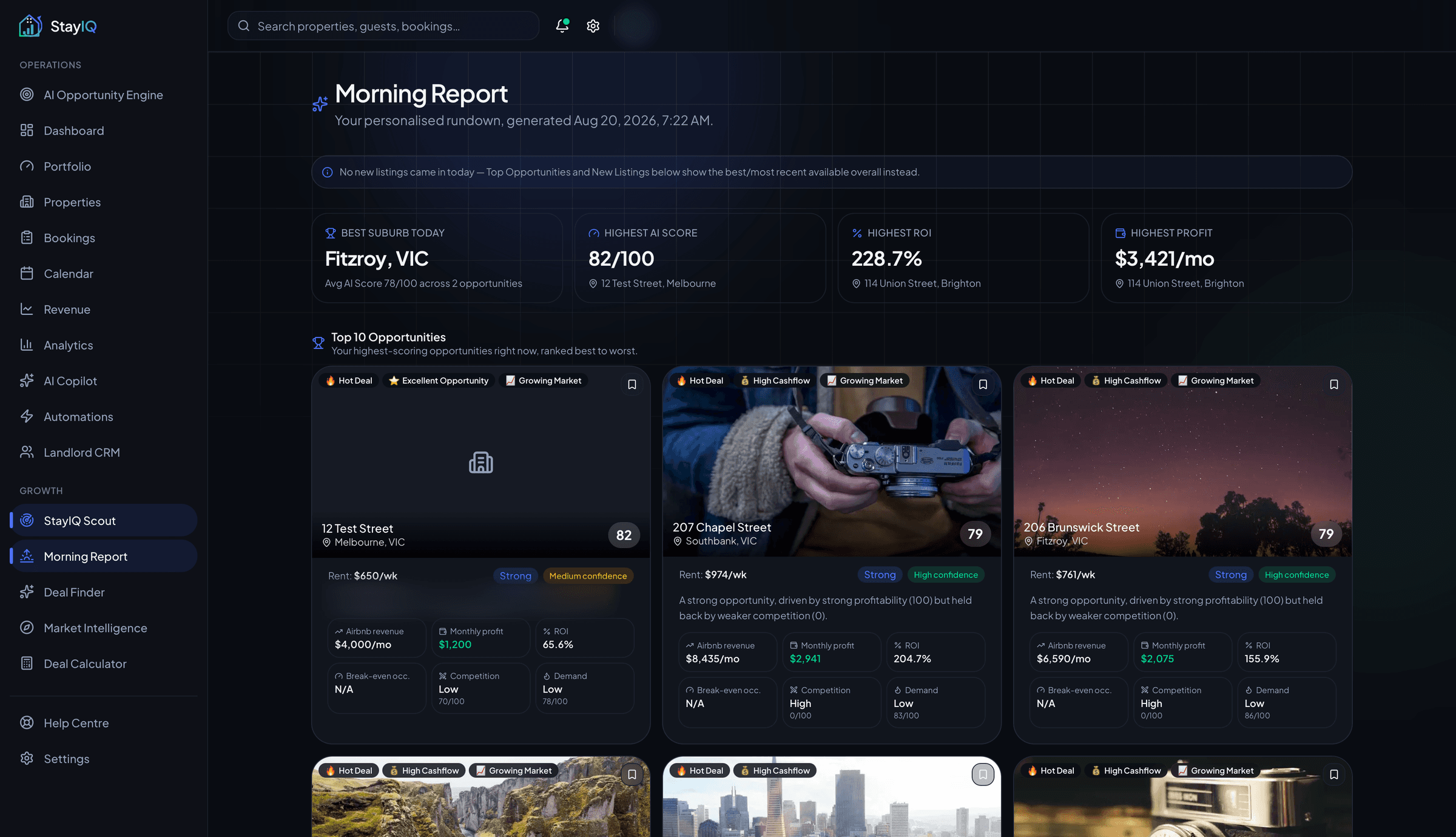
StayIQ turns current information into a prioritised working view.
StayIQ's Morning Report brings property information and calculated measures into a ranked view of current opportunities. It surfaces factors including projected profit, ROI, demand, competition and an AI-assisted opportunity score.
The implementation supports comparison and prioritisation. It does not remove the user from the decision or present a generated score as certainty.
Designed for operating conditions
A useful automation needs boundaries.
- Human oversight
- Define which actions can happen automatically and which require review or intervention.
- Privacy
- Limit what information enters each system, where it is sent and how long it needs to be retained.
- Reliability
- Design for missing information, unavailable services, unexpected inputs and partial failures.
- Cost
- Consider usage volume and ongoing service costs before placing AI inside a repeated process.
- Error handling
- Make failures visible, preserve recoverable information and provide a clear human takeover path.
- Traceability
- Retain enough context to understand what happened where the decision matters.
The safe operating model should be defined alongside the workflow—not added after the system has been built.
Founder-led delivery
Close enough to understand the process.
Ben leads the workflow analysis, interface decisions and technical direction directly. Where a selected specialist can improve an integration, security review or domain-specific part of the engagement, BRS may involve them.
The useful starting point is not “Where can we add AI?” It is “Where is work being repeated, delayed or decided without enough support?”
Bring BRS the workflow that keeps creating friction.
Explain what starts the work, who handles it and where it currently slows down or breaks. BRS can determine whether automation, assistance, integration or no automation is the sensible response.